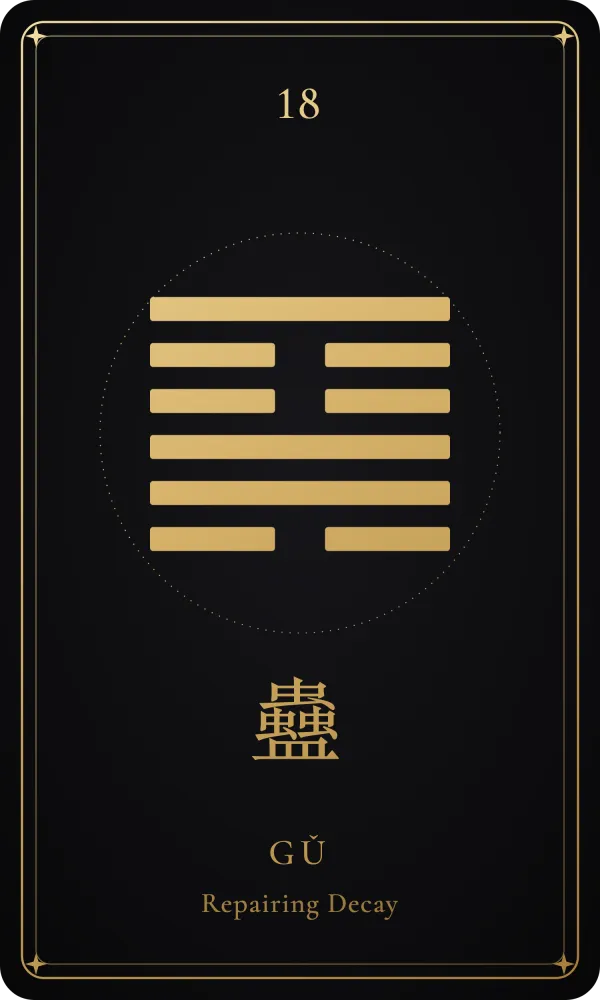
Hexagram 18: Repairing Decay
 By Wendy Zhang, Founder of Solacely · Updated
蠱 · Gǔ
Supreme success. It is favorable to cross the great river. Three days before the starting day, three days after.
The judgment
元亨。利涉大川。先甲三日,後甲三日。
Supreme success. It is favorable to cross the great river. Three days before the starting day, three days after.
The image
山下有風,蠱;君子以振民育德。
Wind blows beneath the mountain: decay. The noble person stirs the people up and nourishes their character.
Wind is trapped beneath the Mountain, so air stagnates and things begin to rot. It pictures inertia above and passive compliance below, a situation spoiled through neglect that now invites renewal.
What Repairing Decay means
Gu shows something that has gone bad through neglect, like food left in a bowl until worms appear. Yet the judgment is surprisingly positive: supreme success, and it is favorable to cross the great river. The decay is a call to repair, and repair is a great work. Commentators read the line texts as correcting the faults inherited from father and mother, meaning patterns from the past that you now carry. The phrase about three days before and after is traditionally read as careful planning before the new beginning and careful follow-through after it. For you, this hexagram may point to a broken system, a stale relationship pattern or a family legacy that needs fixing. Face it with courage and responsibility. The Image says to stir people up and nourish character. Avoid blaming, ignoring the problem or rushing repairs without thinking through causes and consequences.
In love and relationships
Old patterns may be undermining a relationship, perhaps habits inherited from family or past partners. Name them honestly and commit to repair. If single, look at what you bring from earlier relationships and do the work to heal it. Renewal is possible with effort.
At work
Neglected problems, outdated systems or inherited messes need attention. This is a good time to take on a turnaround, reform or cleanup project. Diagnose carefully, plan the fix and follow through. Responsibility here can lead to real success and lasting improvement.
The six lines
Read a line when it is a changing line in your cast (a 6 or a 9).
幹父之蠱,有子考,无咎,厲終吉。
Setting right what the father spoiled. If there is a son, the departed father is free of blame. There is danger, but in the end good fortune.
At the beginning of repair, you take on a problem passed down to you. The decay is not yet deep, so correcting it now is possible. There is some risk in challenging established ways, but your effort redeems the past. Stay aware of the danger and keep going; good fortune follows.
幹母之蠱,不可貞。
Setting right what the mother spoiled. One should not be too rigid.
This strong central line corrects a fault that calls for gentleness. Some problems are tender and personal, rooted in care rather than wrongdoing. Approach them with tact, patience and compassion. Being overly strict or self-righteous here causes harm. Correct firmly but kindly. Warmth makes the change stick.
幹父之蠱,小有悔,无大咎。
Setting right what the father spoiled. There is a little regret, but no great blame.
This strong line in a strong place goes about repair a bit too forcefully. You may cause friction or hurt feelings by being blunt. Some regret is natural, but your motives are good and the effort is necessary. In the end, you avoid serious fault. Soften the delivery where you can.
裕父之蠱,往見吝。
Tolerating what the father spoiled. Going on this way brings humiliation.
This weak line is too lenient and lets the problem slide. Ignoring or excusing a known fault leads to embarrassment later. Do not be passive. Address the issue directly, even if it is uncomfortable. Avoidance makes the decay worse and limits what you can later achieve.
幹父之蠱,用譽。
Setting right what the father spoiled. One earns praise.
As the yielding ruler, you correct what is broken with skill and respect, and you have strong support from line two. Your approach is admired. Others recognize your good work, and you gain a reputation for wisdom and integrity. Carry the repair forward, accepting help from capable people.
不事王侯,高尚其事。
He does not serve kings or lords. He holds his own work to a higher aim.
At the top, outside the cycle of repair, you may not be called to fix this particular problem. Your role may lie elsewhere, in a higher purpose or personal calling. Stepping back from conventional ambitions is not neglect. Honor your own path while still caring about the larger whole.
Advice
Face what has been neglected and commit to repairing it. Plan carefully before you start and follow through after the change.
A question to reflect on
What inherited pattern or neglected problem is ready for me to repair?