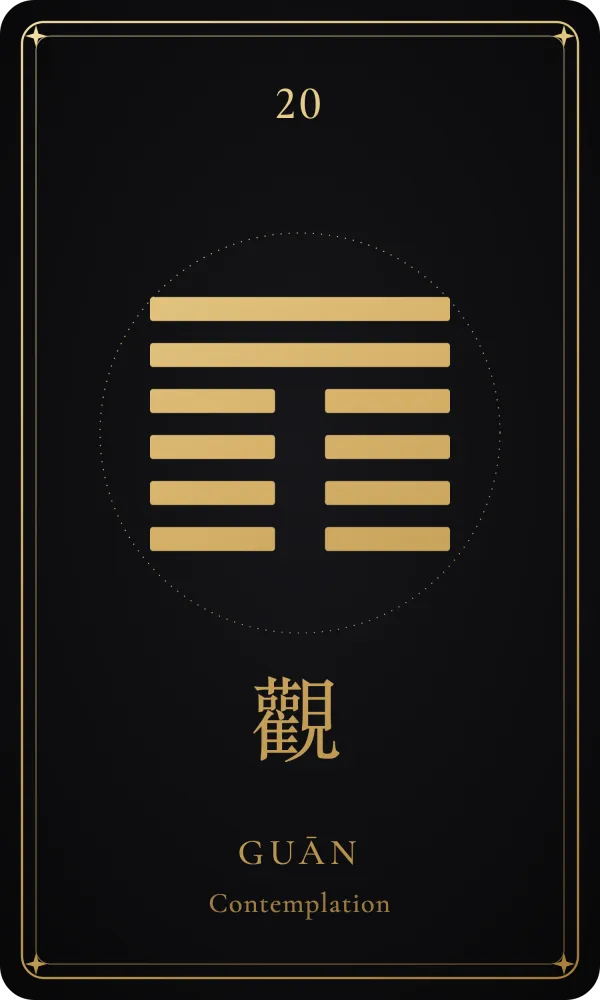
Hexagram 20: Contemplation
 By Wendy Zhang, Founder of Solacely · Updated
觀 · Guān
The hands have been washed, but the offering is not yet made. Full of sincerity, the people look up in reverence.
The judgment
盥而不薦,有孚顒若。
The hands have been washed, but the offering is not yet made. Full of sincerity, the people look up in reverence.
The image
風行地上,觀;先王以省方,觀民設教。
Wind moves over the earth: contemplation. The ancient kings toured the regions, observed the people and set out their teaching.
Wind passes over Earth, reaching everywhere and touching everything. It pictures a broad, observant view, and an example that quietly influences all who see it.
What Contemplation means
Guan is looking deeply, both seeing and being seen. The two strong lines at the top are like a tower from which one surveys the land, and also like a figure the people look up to. The judgment captures the moment in a ritual after the hands are washed and before the offering: a pause full of reverence and focus, when sincerity alone moves those who watch. The image of the trigrams points to observing people and their customs before teaching. For you, this hexagram suggests a time to step back and take in the whole picture, including yourself. Look carefully before acting, and recognize that others are watching how you conduct yourself. Your example teaches more than your words. Avoid shallow judgments, narrow perspectives and acting without understanding. Quiet attention and inner sincerity carry real influence now.
In love and relationships
Observe your relationship honestly. What patterns do you see? If partnered, pay attention to what your partner actually needs. If single, take time to understand what you truly want before rushing in. Remember that how you live is noticed by those who matter.
At work
This is a time to observe, analyze and gain perspective before taking major action. Study the market, your team or your own performance carefully. If you lead, remember that people watch your example. Integrity and consistency inspire more than speeches or directives.
The six lines
Read a line when it is a changing line in your cast (a 6 or a 9).
童觀,小人无咎,君子吝。
Childlike viewing. For a small person, no blame. For the noble person, regret.
At the bottom, far from the tower, this line sees things in a naive and limited way. That is understandable for someone with little at stake. But if you have responsibility or influence, such shallow understanding falls short. Look deeper. Your role asks for a broader and more thoughtful view.
窺觀,利女貞。
Peeking through the crack of a door. Favorable for a woman’s persistence.
Your view is narrow and partial, like glimpsing a room through a door left ajar. In some private situations, this limited perspective is enough. But do not mistake a glimpse for the full picture. Recognize the edges of what you can see, and stay careful before forming strong conclusions.
觀我生,進退。
Contemplating my own life, I decide whether to advance or retreat.
At the top of the inner trigram, the wise move is to look within. Reflect honestly on your actions, your strengths and your limits. That self-examination tells you whether to go forward or pull back. Base the decision on clear self-knowledge rather than outside pressure.
觀國之光,利用賓于王。
Observing the light of the kingdom. It is favorable to be a guest of the king.
This yielding line is correctly placed right beside the ruler. You can see how a well-run place operates, and you have a chance to serve or learn from those in charge. Accept the invitation. Contribute your skills to something larger, and learn from the example of good leadership.
觀我生,君子无咎。
Contemplating my own life. The noble person is without blame.
As the ruling line, you are the one everyone watches. Examine your own conduct and its effects on others. If what you see reflects integrity, you are free of blame. Leaders must look at themselves first, since their example sets the tone for everyone below.
觀其生,君子无咎。
Contemplating his life. The noble person is without blame.
At the top, removed from daily affairs, you still examine your life, now from a wider perspective. Even from a step back, your conduct matters as an example. Reflect on what you have lived and what it teaches others. With integrity, you remain free of blame.
Advice
Step back, observe the whole picture, and reflect on your own conduct. Let your example speak sincerely.
A question to reflect on
If I looked at my life the way a calm observer would, what would I notice?