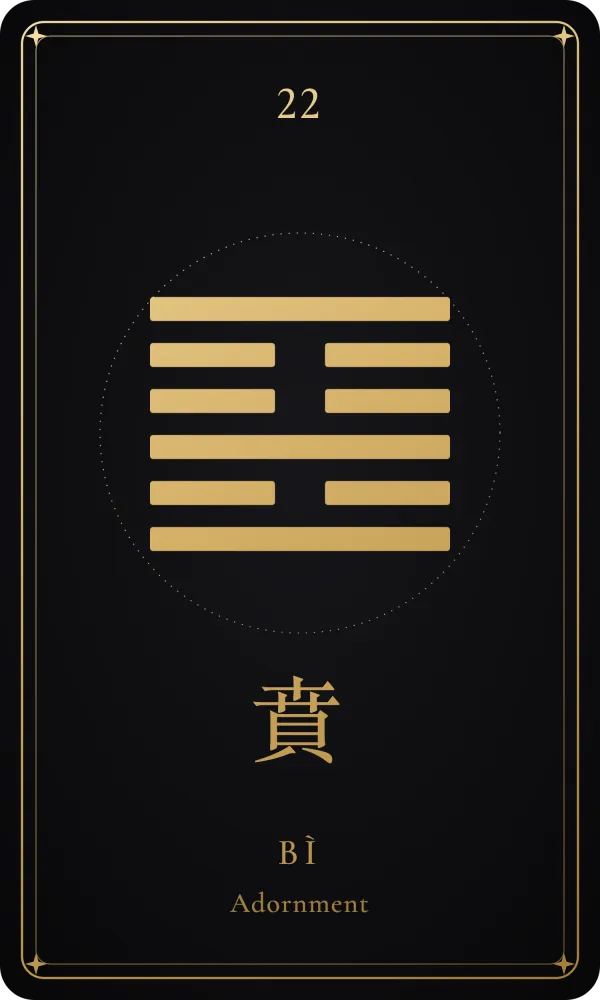
Hexagram 22: Adornment
 By Wendy Zhang, Founder of Solacely · Updated
賁 · Bì
Success. It is slightly favorable to have somewhere to go.
The judgment
亨。小利有攸往。
Success. It is slightly favorable to have somewhere to go.
The image
山下有火,賁;君子以明庶政,无敢折獄。
Fire at the foot of the mountain: adornment. The noble person brings clarity to everyday affairs, but does not dare to settle serious disputes on that basis.
Fire glows at the foot of the Mountain, lighting its slopes with beauty. It pictures grace and form that make things lovely, but only reach so far; the light does not change the mountain itself.
What Adornment means
Bi is adornment: grace, form and beauty that give shape to life. Fire at the base of the mountain illuminates its contours, so things look clear and attractive. The judgment grants success but only small benefit in going forward: beauty enhances but cannot carry great matters alone. The Image adds a careful distinction: use clarity and good form in everyday administration, but do not decide serious disputes on appearances. For you, this hexagram suggests that presentation, style, courtesy and aesthetic care matter now, and they can improve how things go. Yet substance must remain primary. The final line, plain white adornment, shows the highest grace as simplicity: beauty that grows out of genuine character. Enjoy and use form well, but do not let it replace content. Avoid vanity, judging by surface and spending too much energy on image.
In love and relationships
Attraction, charm and romance are highlighted. Enjoy the beauty of courtship and care in how you present yourself. If partnered, small gestures and aesthetic touches renew affection. But look beyond surface appeal; lasting love rests on character, honesty and shared values.
At work
Presentation matters: polish your materials, refine your design, communicate gracefully. These details can make a real difference. But do not rely on style to cover weak substance, and do not judge others solely by appearance. Make sure the work itself is sound.
The six lines
Read a line when it is a changing line in your cast (a 6 or a 9).
賁其趾,舍車而徒。
He adorns his toes, leaves the carriage and walks.
At the bottom, you choose integrity over status. You would rather walk on your own feet than ride in borrowed comfort. That simple choice is its own adornment. Do not accept shortcuts or perks that compromise your independence. Modest, honest steps carry more grace than an impressive ride.
賁其須。
He adorns his beard.
A beard moves only with the chin. This yielding line attaches itself to the strong line above and moves with it. Your adornment or role depends on someone else’s direction. That is fine if you choose a worthy partner, but notice that style here follows substance rather than standing alone.
賁如濡如,永貞吉。
Adorned and glistening. Lasting persistence brings good fortune.
This strong line sits between two yielding lines and enjoys a pleasant, glowing moment. Things look and feel good. The risk is sinking into comfort and losing your edge. Keep your integrity steady over time; that steady character, more than the pleasant glow, brings good fortune.
賁如皤如,白馬翰如,匪寇婚媾。
Adorned, yet plain and white. A white horse comes as if on wings. Not a robber, but a suitor.
You hesitate between ornate display and simple sincerity, and you lean toward simplicity. Someone approaches swiftly. Though their arrival may seem unsettling at first, their intentions are good. Choose plain honesty over elaborate show, and welcome a genuine connection when it appears. A plain, honest answer serves you best here.
賁於丘園,束帛戔戔,吝,終吉。
Adornment in the hills and gardens. The roll of silk is meager. Humiliation, but in the end good fortune.
As the yielding ruler, you turn away from lavish display toward a simple, natural life. Your offering may seem small or modest, even a little embarrassing. Yet that sincerity matters more than abundance. In the end, a modest gift with real feeling brings good fortune.
白賁,无咎。
Plain white adornment. No blame.
At the top, adornment returns to simplicity. The highest beauty is plain, honest and unadorned. Let go of extra ornament and show yourself as you are. That clean simplicity is free of blame and carries a deep kind of grace that does not depend on decoration.
Advice
Bring care and grace to how you present things, while keeping substance first. Let simplicity be your highest style.
A question to reflect on
Where am I paying more attention to appearances than to substance, or the reverse?