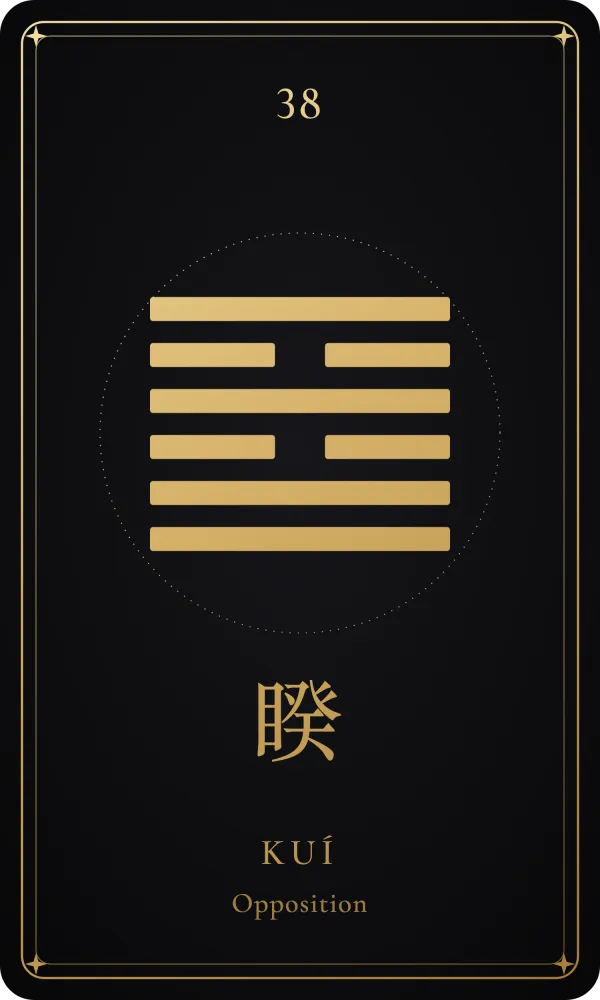
Hexagram 38: Opposition
 By Wendy Zhang, Founder of Solacely · Updated
睽 · Kuí
Opposition. In small matters, good fortune.
The judgment
小事吉。
Opposition. In small matters, good fortune.
The image
上火下澤,睽;君子以同而異。
Fire above, lake below: the image of Opposition. The noble person seeks common ground while keeping their differences.
Fire flames upward while the lake seeps downward; they move apart. Two daughters in one house whose wills do not align, a picture of separation that still holds the chance of complement.
What Opposition means
Opposition describes a time when people or forces pull in different directions. Like fire and water in one image, they naturally move apart, and like two sisters under one roof, they want different things. The judgment is modest: only small undertakings go well. Large joint ventures need a level of agreement that does not exist yet. Yet the Commentary on the Judgment sees value here: heaven and earth are opposite yet work together, men and women differ yet seek each other. Difference can become complement. The Image asks you to find unity while preserving distinctions: cooperate where you can without pretending to be the same. In practice, this may mean misunderstandings, suspicion, or feeling isolated. The lines show that patience, small gestures, and checking your assumptions often reveal that the supposed enemy is an ally. Avoid forcing consensus or escalating conflict. Small, sincere moves rebuild trust.
In love and relationships
Differences in love may feel sharp now: different needs, schedules, or ways of expressing care. Rather than pushing for complete agreement, honor what is genuinely different while looking for shared ground. Small kind gestures repair more than big talks. Watch for misunderstandings that are bigger in your mind than in reality.
At work
Colleagues or partners may not be aligned, and grand collaborative plans may stall. Focus on small, achievable tasks where you can cooperate. Respect different working styles instead of insisting on uniformity. Before assuming bad intent, check the facts; many conflicts here turn out to be misreadings.
The six lines
Read a line when it is a changing line in your cast (a 6 or a 9).
悔亡,喪馬勿逐,自復;見惡人无咎。
Regret disappears. If you lose your horse, do not chase it; it will come back on its own. Meeting bad people brings no blame.
Something has drifted away, perhaps a person or an opportunity. Chasing it would push it farther. Let it return in its own time. Meanwhile, do not refuse contact with people you dislike or distrust; courteous meetings prevent enmity and protect you. Calm patience resolves more than pursuit.
遇主于巷,无咎。
Meeting the master in a narrow lane. No blame.
Normal channels are closed, so contact happens by an unexpected, informal route. This strong central line meets its counterpart, the yielding ruler in the fifth place, in an unlikely setting. Use side doors when the main entrance is shut: a chance conversation, an informal call. Such meetings are legitimate and can restore connection.
見輿曳,其牛𧤊,其人天且劓,无初有終。
You see the wagon dragged back, its oxen halted, its driver branded and his nose cut off. No good beginning, but a good end.
Everything seems to block you, and you may feel misjudged or punished. This line sits in an awkward place between two strong lines. The start is hard, but the line promises a good outcome if you hold steady. Do not let early obstacles define the whole story.
睽孤,遇元夫,交孚,厲无咎。
Isolated by opposition, you meet a fine person and trust each other. Danger, but no blame.
Feeling alone in conflict, you find someone genuinely aligned with you, a kindred person whose sincerity matches yours. That mutual trust makes it possible to get through a risky period. Look for one honest ally rather than a crowd. Shared good faith outweighs the danger of the situation.
悔亡,厥宗噬膚,往何咎。
Regret disappears. Your kin bite through the skin. If you go forward, what blame could there be?
The barrier between you and a true ally is thin, as easy to bite through as tender skin. This yielding ruler is supported by the strong central line below. What separated you is easily removed once someone takes the first step. Reach out. The connection is closer than it seemed.
睽孤, 見豕負涂,載鬼一車, 先張之弧,後說之弧,匪寇婚媾,往遇雨則吉。
Isolated by opposition, you see a pig covered with mud, a wagon full of demons. First you draw your bow, then you lay it down. Not a raider but a suitor. Going forward and meeting the rain brings good fortune.
At the extreme of isolation, suspicion distorts everything: friends look like threats. Eventually you see clearly, put down your defenses, and recognize that the ‘enemy’ came in goodwill. Rain, which releases tension, marks reconciliation. Question your fears before acting on them, and allow relief to come.
Advice
Keep your differences, but find the ground you share. Make small, sincere moves instead of forcing large agreements.
A question to reflect on
Which conflict in my life might soften if I questioned my assumptions about the other person?