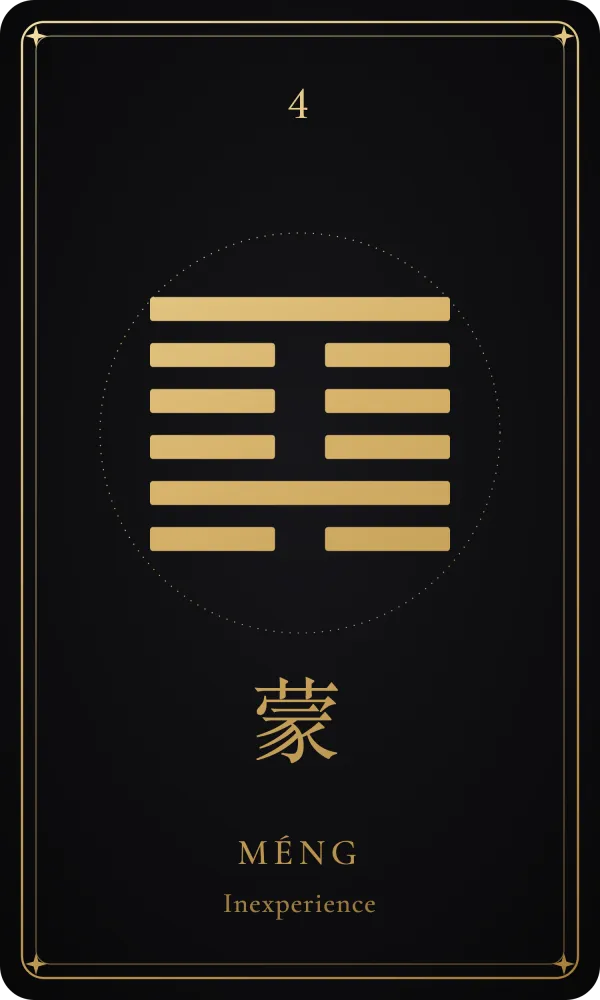
Hexagram 4: Inexperience
 By Wendy Zhang, Founder of Solacely · Updated
蒙 · Méng
Success. It is not I who seek the young fool; the young fool seeks me. At the first consultation I answer. Asking a second and third time is disrespectful, and to the disrespectful I give no answer. Persistence is favorable.
The judgment
亨。匪我求童蒙,童蒙求我。初筮告,再三瀆,瀆則不告。利貞。
Success. It is not I who seek the young fool; the young fool seeks me. At the first consultation I answer. Asking a second and third time is disrespectful, and to the disrespectful I give no answer. Persistence is favorable.
The image
山下出泉,蒙;君子以果行育德。
A spring flows out at the foot of the mountain: inexperience. The noble person acts decisively and nurtures character.
Water rises beneath Mountain: a fresh spring at the foot of a hill that does not yet know which way to flow. It pictures untutored potential that needs direction, patience and clear teaching.
What Inexperience means
Meng is about not knowing yet, and about the right relationship between learner and teacher. The young fool here is not stupid, only inexperienced, and the judgment insists that the learner must come seeking, with sincerity. Asking the same question again and again, hoping for a different answer, closes the door. For you, this hexagram may point to an area where you are a beginner, or to a role in which you guide someone else. Either way, learning works through respect, focus and practice. The Image of a spring at the foot of a mountain suggests energy that has not found its course: decisive action and patient character-building give it direction. Zhu Xi reads the hexagram as the work of clearing ignorance gradually. Avoid pretending to know, repeating questions you have already been answered, and teaching through either harshness or indulgence alone.
In love and relationships
You may be uncertain how to read a situation or a person. Ask honestly and listen to the answer rather than seeking reassurance repeatedly. If you are single, be open to learning what you truly want. In a relationship, mutual patience with each other’s inexperience builds trust.
At work
A learning curve is ahead. Find a good mentor, ask clear questions and practice consistently. If you are training someone, be clear and firm, with room for growth. Avoid bluffing competence; humility now speeds up mastery and earns you the patience of the people around you.
The six lines
Read a line when it is a changing line in your cast (a 6 or a 9).
發蒙,利用刑人,用說桎梏,以往吝。
Clearing away inexperience. It is useful to apply discipline, and to remove the shackles. Going on in that way brings regret.
Structure helps a beginner, and some firmness now is useful, whether you are the student or the guide. But discipline should free, not bind. Set clear rules and habits, then loosen them as competence grows. Rigid control kept too long breeds resentment and stalls progress.
包蒙吉,納婦吉,子克家。
Bearing with the inexperienced brings good fortune. Taking a wife brings good fortune. The son is able to manage the household.
This is the strong central line, the true teacher of the hexagram. You can afford to be patient and generous with those still learning, and that kindness produces good results. You are capable of carrying responsibility, even if your role is not the highest. Lead gently and include people rather than judging them.
勿用取女,見金夫,不有躬,无攸利。
Do not take a woman who, seeing a man of gold, loses hold of herself. Nothing is favorable.
This weak line in a strong place is easily dazzled by status, money or charm, and abandons its own integrity. Beware of attaching yourself to whatever glitters, and beware of people who do. Learning requires a steady center. Hold your ground and do not trade your self-respect for a shortcut.
困蒙,吝。
Confined in inexperience. Regret.
You are isolated from the guidance you need, far from the strong lines that could teach you. Staying stuck in your own limited view brings humiliation. Break the isolation: look for a teacher, a resource or honest feedback. The problem is not lack of ability but lack of contact with someone who knows more.
童蒙,吉。
Childlike inexperience. Good fortune.
In the ruling place, this yielding line is open, trusting and ready to learn, and it receives from the strong second line. A beginner’s mind is your advantage here. Ask simple questions, accept guidance without ego and stay curious. That openness leads to good fortune and faster growth than pretending to have answers.
擊蒙,不利為寇,利禦寇。
Striking at inexperience. It does not help to act like a raider. It helps to guard against raiders.
Correction may be needed, but harshness does more harm than good. Use firmness to protect, not to punish. Set boundaries against what genuinely threatens learning, such as bad influences or bad habits, rather than attacking the learner. Strict limits can be kind when their aim is to keep someone safe while they grow.
Advice
Approach this as a sincere learner: ask once, listen fully and put the answer into practice before asking again.
A question to reflect on
Where am I still a beginner, and what would it look like to learn this well instead of quickly?