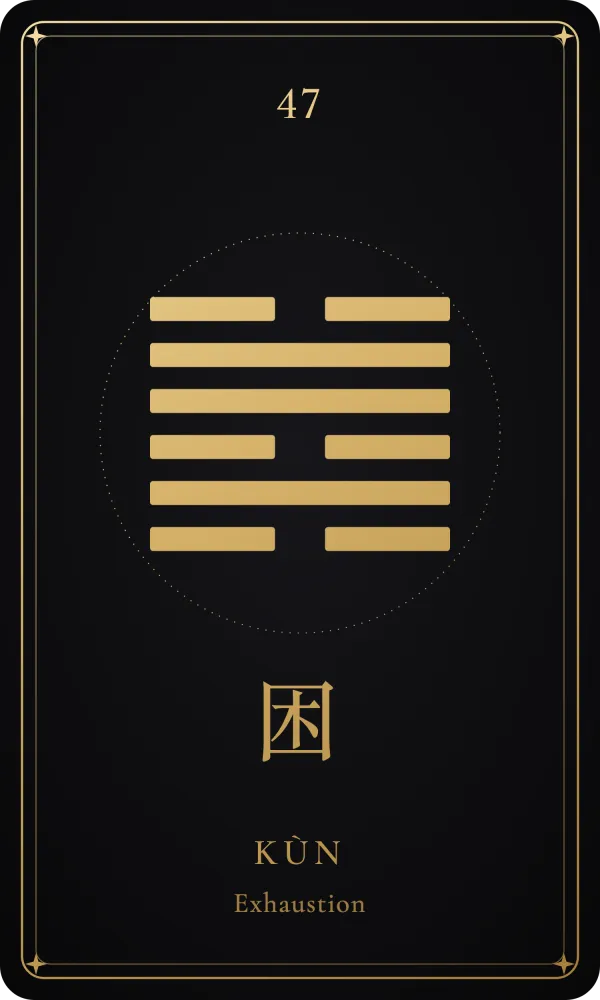
Hexagram 47: Exhaustion
 By Wendy Zhang, Founder of Solacely · Updated
困 · Kùn
Exhaustion. Success. Persistence brings good fortune to the great person. No blame. Words are not believed.
The judgment
亨,貞大人吉,无咎,有言不信。
Exhaustion. Success. Persistence brings good fortune to the great person. No blame. Words are not believed.
The image
澤无水,困;君子以致命遂志。
A lake with no water: the image of Exhaustion. The noble person stakes their life on fulfilling their purpose.
Water has drained out below the lake, leaving it dry. Joy above with danger below: outward pressure has depleted resources, leaving only inner strength.
What Exhaustion means
Exhaustion describes a time of constraint, fatigue, or adversity. Resources are depleted, efforts seem unrewarded, and you may feel trapped. Yet the judgment says success is possible for the great person who persists. The key is inner steadiness: holding to purpose even when outward conditions are poor. The judgment also notes that words are not believed; explanations and complaints may not help. Actions and character speak louder. Commentators observe that adversity tests and refines; those who stay true find a way through. The Image is intense: be willing to give everything for your purpose. In real terms, this hexagram may describe burnout, financial strain, or feeling misunderstood. It asks you to conserve energy, avoid useless talk, and protect your core values. Keep cheerful where possible, as the upper trigram suggests. Avoid despair, bitterness, and impulsive moves. This exhaustion is a test that can deepen resilience.
In love and relationships
Love may feel strained or depleted. Communication may not land, and efforts may seem unappreciated. Focus on quiet, steady care instead of arguments. Look after your own wellbeing so you do not collapse. If you are single, use this time to rebuild your inner resources before seeking a new connection.
At work
Work may feel stuck or exhausting: limited resources, unappreciated effort, or obstacles from others. Save your words and let results speak. Protect your energy and focus on what is truly essential. Consider whether you need rest or support. This difficult time can build strength if you stay principled.
The six lines
Read a line when it is a changing line in your cast (a 6 or a 9).
臀困于株木,入于幽谷,三歲不覿。
Sitting oppressed under a bare tree, he enters a dark valley and is not seen for three years.
You sit stuck beneath a bare tree and drift into a dark valley, feeling unseen and without shelter. This weak line at the bottom tends to sink into discouragement and hide. Notice that pull toward total withdrawal. Reach for any light available, a friend, a small routine, an outside view, before isolation deepens. The gloom is real, but it is not the whole truth.
困于酒食,朱紱方來,利用亨祀,征凶,无咎。
Exhausted by food and wine. The scarlet sash is coming. It is favorable to make offerings. Setting out brings misfortune, but no blame.
This strong central line is weighed down by plenty rather than lack: too many obligations, too much rich food, a load of comfort that still feels confining. Recognition, pictured by the official’s scarlet sash, is on its way. Stay inwardly devoted and patient, as in the offering. Rushing toward new ventures now would bring trouble, though not blame.
困于石,據于蒺蔾,入于其宮,不見其妻,凶。
Oppressed by stone, leaning on thorns. Entering his house, he does not see his wife. Misfortune.
You push against stone and lean on thorns, relying on supports that only hurt you. Coming home, you find no one there. This weak line in a strong place reacts poorly under pressure and makes matters worse. Stop struggling against what will not move and stop leaning on what wounds you. Clear, honest assessment is needed far more than force.
來荼荼,困于金轝,吝,有終。
He comes slowly, hindered by a golden carriage. Humiliation, but the end is good.
Help arrives slowly, held up by a golden carriage: status, wealth, or bureaucracy that gets in the way of simple action. You may feel embarrassed by how long it is taking, and that discomfort is acknowledged. Yet the line promises a good ending. Keep moving, even slowly. Your intentions are sound, and your eventual arrival will matter to those waiting.
劓刖,困于赤紱,乃徐有說,利用祭祀。
Nose and feet cut off. Oppressed by the man in the scarlet sash. Joy comes slowly. It is favorable to make offerings.
The ruler is hemmed in from above and below, even by officials who should cooperate, and the punishments of nose and feet picture that frustration. Yet this strong central line has inner resources. Relief comes gradually rather than all at once. Keep acting with sincerity and devotion, as one would in a sacrifice. Joy returns slowly, but it does return.
困于葛藟,于臲卼,曰動悔。有悔,征吉。
Oppressed by creeping vines, unsteady and shaken. He says, ‘If I move, I will regret it.’ Having regretted, going forward brings good fortune.
At the top, you are tangled in creeping vines and teetering, telling yourself that any move will be a mistake. The constraints are weaker than they feel. Acknowledge what you regret, then act decisively. The text is clear: once regret is faced honestly, going forward brings good fortune. Stillness born of fear is what keeps the vines wrapped around you.
Advice
Conserve your energy, stay true to your purpose, and let your actions speak more than your words.
A question to reflect on
What inner resource can I rely on when outer support feels thin?