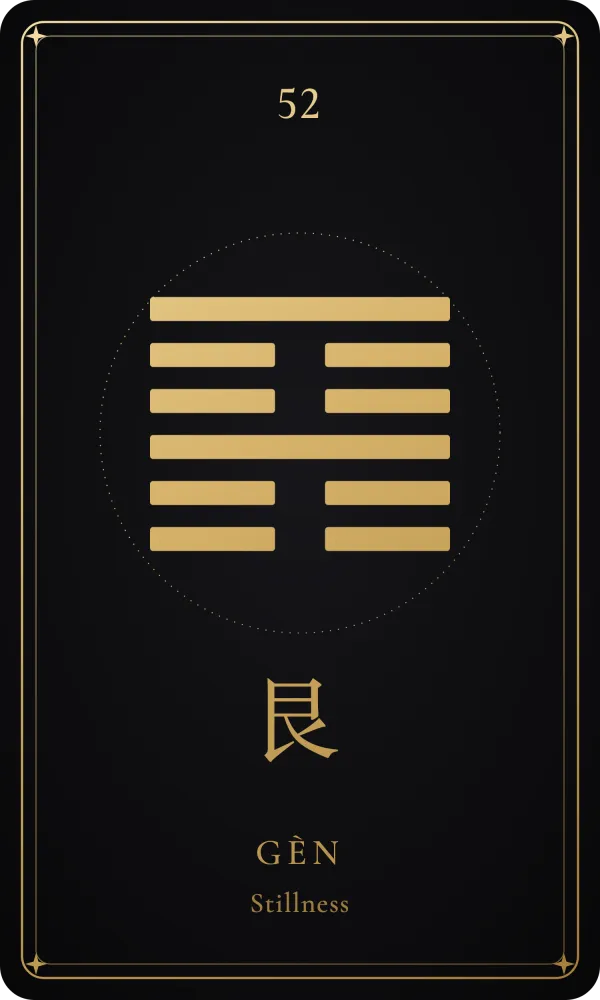
Hexagram 52: Stillness
 By Wendy Zhang, Founder of Solacely · Updated
艮 · Gèn
Stillness. Keeping the back still, he no longer feels the self. Walking in his courtyard, he does not see his people. No blame.
The judgment
艮其背,不獲其身,行其庭,不見其人,无咎。
Stillness. Keeping the back still, he no longer feels the self. Walking in his courtyard, he does not see his people. No blame.
The image
兼山,艮;君子以思不出其位。
Mountains joined together: the image of Stillness. The noble person does not let their thoughts go beyond their situation.
Mountain upon mountain: double solidity and rest. Each trigram has one yang line resting at the top of two yin lines, a picture of firm stopping.
What Stillness means
Stillness, represented by doubled mountains, is the art of stopping at the right time. The judgment describes keeping the back still: the back is the part of the body that does not see or reach for anything. When you are still in this way, you are not driven by the ego’s desires, and even in a busy courtyard you are not pulled by every encounter. The Tuan commentary explains that stopping when it is time to stop and moving when it is time to move is the essence of wisdom. The Image asks that your thoughts not exceed your position: stay present and focused on what is actually yours. Day to day, this hexagram may suggest rest, meditation, setting limits, or pausing a project. Avoid restlessness, overthinking, and pushing past what is right. Stillness is not passivity; it is the grounded calm from which wise action comes.
In love and relationships
Love asks for calm presence now. Avoid pressuring decisions or overanalyzing every signal. Sometimes simply being together quietly says more than conversation. If a pause is needed, take it gracefully. Singles may benefit from stepping back from seeking and letting things unfold naturally.
At work
Work may call for a pause, consolidation, or setting clear boundaries. Focus on what is actually your responsibility and avoid overreaching. Taking time to reflect before acting can prevent mistakes. Rest and recovery support future productivity. Knowing when to stop is a professional skill.
The six lines
Read a line when it is a changing line in your cast (a 6 or a 9).
艮其趾,无咎,利永貞。
Keeping the toes still. No blame. Lasting persistence is favorable.
You stop at the toes, before the first step is taken. Halting here is easy and prevents a wrong course. This yielding line at the bottom is wise to hold still. Keep your patience and stay consistent over time. Early restraint costs little, keeps you out of mistakes, and leaves your options open for when movement is truly right.
艮其腓,不拯其隨,其心不快。
Keeping the calves still. He cannot rescue the one he follows. His heart is not glad.
You keep the calves still but cannot stop the thigh above from moving, so you are carried along by someone else’s momentum. This central, correct line knows better, yet cannot rescue the one it follows, and the heart is unhappy. Recognize the limits of your influence. Stay true to your own judgment even when you cannot change the wider direction.
艮其限,裂其夤,厲閽心。
Keeping the waist still, straining the spine. Danger; the heart is smothered.
Stopping at the waist, stiffening the spine until it strains: this is stillness forced too hard. Suppressing natural movement or feeling creates tension that smolders like a fire in the chest. This strong line at the junction of the trigrams clamps down. Find a gentler calm. Genuine stillness is relaxed and settled, not rigid and clenched.
艮其身,无咎。
Keeping the trunk still. No blame.
Stillness reaches the trunk, the core of the self. You can quiet restless impulses and rest within, even if full mastery is not yet yours. This yielding line in its correct place is content to be still where it is. Keep practicing that grounded presence. It brings no blame and quietly steadies everything around you.
艮其輔,言有孚,悔亡。
Keeping the jaw still. Words have order. Regret disappears.
In the ruler’s place, stillness reaches the jaw. Speak with order and restraint, choosing your words rather than letting them spill. Avoid careless talk, quick promises, or gossip. When what you say is measured and sincere, misunderstandings fade and earlier regrets fall away. Disciplined speech is one of the most practical forms of stillness.
敦艮,吉。
Steadfast stillness. Good fortune.
At the top, stillness becomes generous and complete, solid as a mountain summit. Zhu Xi calls this the fullness of stopping: calm that has become character. It brings good fortune. Let your steadiness support those around you, and stay committed to the quiet you have found. This is the most stable resting point the hexagram offers.
Advice
Pause and let your mind settle where you actually are. Stop when it is time to stop.
A question to reflect on
Where in my life do I need to stop, and what would stillness reveal?