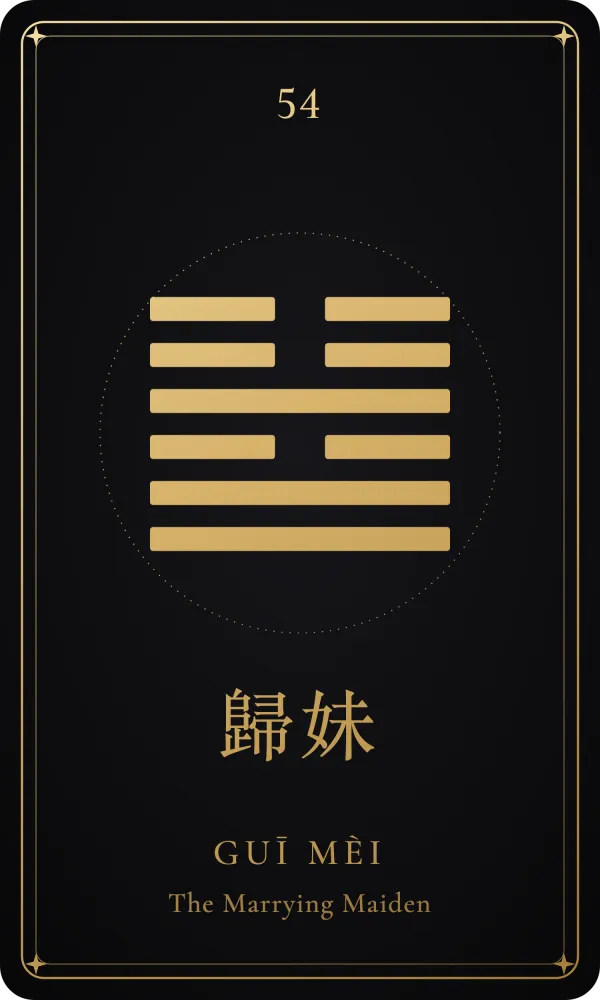
Hexagram 54: The Marrying Maiden
 By Wendy Zhang, Founder of Solacely · Updated
歸妹 · Guī Mèi
The Marrying Maiden. Setting out brings misfortune. Nothing is favorable.
The judgment
征凶,无攸利。
The Marrying Maiden. Setting out brings misfortune. Nothing is favorable.
The image
澤上有雷,歸妹;君子以永終知敝。
Thunder over the lake: the image of the Marrying Maiden. The noble person understands the lasting end and recognizes what will wear out.
Thunder (the eldest son) moves above the lake (the youngest daughter): attraction driven by impulse rather than proper order, a relationship where one party holds little power.
What The Marrying Maiden means
The Marrying Maiden refers to a younger woman who enters a household as a secondary wife. The relationship begins from impulse and desire, and her position is subordinate. The judgment is stern: setting out brings misfortune, and nothing is beneficial. Taken more broadly, this hexagram describes situations where you have limited control or must accept a secondary role, such as a junior job, an uneven partnership, or an arrangement entered too hastily. The Commentary on the Judgment notes that improper positions lead to misfortune. Yet the Image offers wisdom: understand where things are heading and recognize what will not last. Commentators advise humility, patience, and careful attention to propriety. Concretely, avoid forcing advancement, overstepping, or acting on raw desire. Work within your role, keep integrity, and be clear about expectations. Relationships and commitments formed hastily may falter; those built on mutual respect endure.
In love and relationships
Love may involve unequal dynamics or a relationship formed too quickly. Consider whether expectations are clear and roles fair. Do not rush commitment based on attraction alone. If you are in a secondary position, protect your dignity. Real love requires respect and balanced footing.
At work
You may hold a junior or subordinate role with limited influence. Work well within it, deliver excellent results, and avoid overstepping. Be wary of commitments made in haste before you understand the terms. Over time, patience and professionalism can improve your standing far more reliably than pushing for status you have not yet secured.
The six lines
Read a line when it is a changing line in your cast (a 6 or a 9).
歸妹以娣,跛能履,征吉。
The maiden marries as a junior wife. The lame can still walk. Setting out brings good fortune.
The maiden marries as a junior wife, like a lame person who can still walk. Your position is secondary, yet you can contribute meaningfully. This strong line at the bottom has real ability held within a modest role. Serve faithfully and well within it. Good fortune follows when you accept your place with grace while doing excellent work.
眇能視,利幽人之貞。
The one-eyed can still see. Persistence is favorable for the solitary person.
Like someone with one eye who can still see, this strong central line is paired with an unsuitable partner or situation. You see clearly enough, though not fully supported. Keep your integrity quietly, even if you feel alone in doing so. The steadiness of a solitary, private person who holds to their values is what sustains you.
歸妹以須,反歸以娣。
The maiden marries as a waiting servant; she returns and marries as a junior wife.
The maiden goes as a waiting servant and comes back as a junior wife. Grasping for a better position out of impatience ends in a lower one. This weak line in a strong place wants more than it can claim. Accept your current role for now and wait for a proper opening. Rushing only undermines your standing.
歸妹愆期,遲歸有時。
The maiden delays her marriage. A late marriage comes in its own time.
The maiden lets the wedding date pass, waiting for a better match, and a late marriage comes in its time. Choosing to hold back from an unsuitable arrangement preserves your dignity. Delay may be frustrating, but it leads to something better. Trust the timing and do not settle merely to be settled. Patience here is self-respect.
帝乙歸妹,其君之袂,不如其娣之袂良,月幾望,吉。
King Yi gives his daughter in marriage. The princess’s sleeves are not as fine as those of her bridesmaid. The moon is nearly full. Good fortune.
King Yi marries off his daughter, and her sleeves are plainer than her bridesmaid’s. In the ruler’s place, this yielding central line shows nobility through modesty, not display. True dignity lies in character. The moon nearly full suggests fullness held just short of excess. Humble grace in a high position brings good fortune.
女承筐无實,士刲羊无血,无攸利。
The woman holds a basket with nothing in it. The man stabs the sheep, but no blood flows. Nothing is favorable.
The woman holds a basket with nothing in it; the man cuts the sheep and no blood comes. The ritual is hollow: gestures without substance, commitment without content. If a relationship or agreement exists only for show, nothing can grow from it. Seek genuine engagement or step away honestly. Empty forms bring no benefit to anyone involved.
Advice
Accept the limits of your current role with dignity, and think about where things are heading before you commit.
A question to reflect on
Where am I acting on impulse instead of considering the long-term outcome?